
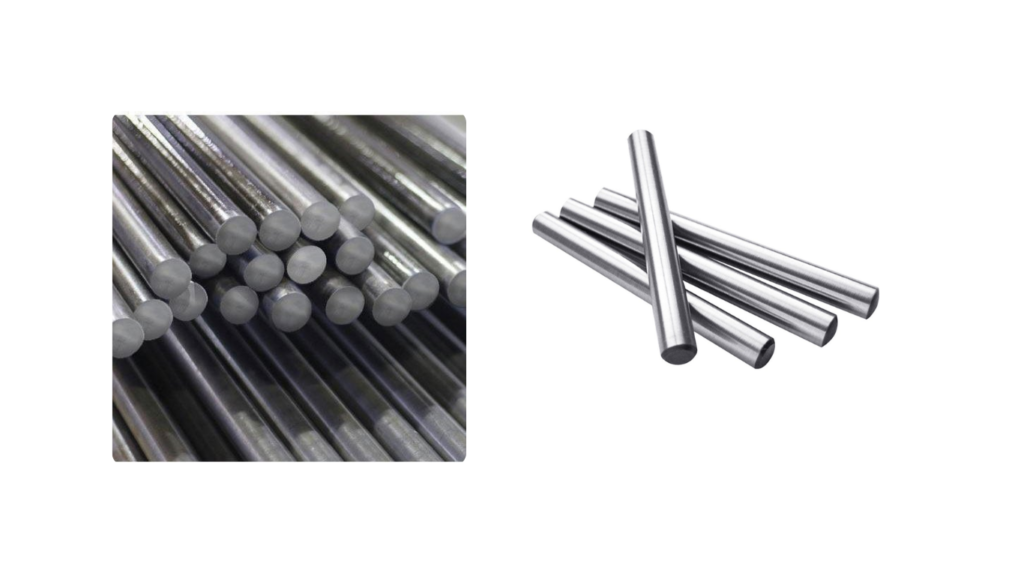
17-4 PH stainless steel is a precipitation-hardening stainless steel developed for applications where high strength, hardness and corrosion resistance are required together.
Also known as UNS S17400 stainless steel, AISI SS 630 stainless steel and commonly associated with EN 1.4542, 17-4 PH is a martensitic precipitation/age-hardening stainless steel. Its final mechanical properties can be adjusted through controlled aging treatments such as H900, H1025 and H1150.
Because of this combination of strength and corrosion resistance, 17-4 PH is used across aerospace, energy, chemical processing, industrial equipment, valves, fittings, pumps, manifolds and other demanding engineering applications.
What Is 17-4 PH Stainless Steel?
17-4 PH stainless steel is a martensitic precipitation-hardening stainless steel containing chromium, nickel, copper and niobium/tantalum.
The name “17-4” generally refers to its nominal alloying concept of approximately 17% chromium and 4% nickel, while the precipitation-hardening response is associated with additions including copper and niobium. The standard material is identified as UNS S17400 and is also known as Type 630.
Unlike conventional stainless steel grades where strength is primarily controlled by composition and conventional heat treatment, 17-4 PH can be age hardened to achieve different combinations of strength, hardness and toughness.
This makes it useful when a component needs both stainless-steel corrosion resistance and high mechanical strength.
Why Is 17-4 PH Called Precipitation-Hardening Stainless Steel?
What Does Precipitation Hardening Mean?
Precipitation hardening, also called age hardening, is a heat-treatment process used to increase the strength and hardness of certain alloys.
In 17-4 PH stainless steel, the material is first solution treated and then aged at a controlled temperature. During aging, fine strengthening precipitates form within the microstructure, increasing the material's strength and hardness.
The aging condition can be selected according to the application's requirements.
For example:
H900 is used when very high strength and hardness are required.
H1025 provides a different balance of strength and toughness.
H1150 provides lower strength but generally higher toughness and ductility than the lower-temperature aging conditions.
The exact mechanical properties depend on product form, specification and heat-treatment condition, so the applicable material standard and mill test report should always be checked.
17-4 PH stainless steel composition
A typical composition range for 17-4 PH alloy composition / UNS S17400 composition is shown below. Actual chemistry should be confirmed against the applicable material specification and mill test certificate.
| ElementTypical / Specified Range | |
|---|---|
| Chromium (Cr) | 15.00–17.50% |
| Nickel (Ni) | 3.00–5.00% |
| Copper (Cu) | 3.00–5.00% |
| Niobium + Tantalum (Nb + Ta) | 0.15–0.45% |
| Carbon (C) | 0.07% max |
| Manganese (Mn) | 1.00% max |
| Silicon (Si) | 1.00% max |
| Phosphorus (P) | 0.040% max |
| Sulfur (S) | 0.030% max |
| Iron (Fe) | Balance |
The combination of chromium, nickel, copper and niobium/tantalum contributes to the alloy's corrosion resistance and precipitation-hardening response.
Key Properties of 17-4 PH Stainless Steel
High Strength
One of the main reasons industries select 17-4 PH stainless steel strength is its ability to achieve high mechanical strength after aging.
Different aging conditions can produce different strength levels, allowing engineers to select a condition according to the application.
High Hardness
17-4 PH stainless steel hardness can achieve significantly higher hardness than common austenitic stainless steels such as 304 and 316 when appropriately heat treated.
This makes it suitable for components exposed to mechanical loads, wear and demanding operating conditions.
Corrosion Resistance
17-4 PH stainless steel corrosion resistance offers good corrosion resistance and is generally more corrosion resistant than many conventional hardenable martensitic stainless steels. Its corrosion performance, however, depends on the environment, surface condition and heat-treatment condition.
Good Toughness
17-4 PH stainless steel toughness can provide a useful combination of strength and toughness. The selected aging condition has an important influence on the final balance of these properties.
Dimensional Stability
The precipitation-hardening process uses relatively low-temperature aging compared with conventional hardening processes used for some tool steels. This can be advantageous when dimensional control is important.
17-4 PH Stainless Steel Heat Treatment
Heat treatment is one of the most important aspects of 17-4 PH stainless steel.
The material is commonly supplied in a solution-treated condition and subsequently aged to develop the required mechanical properties.
Condition A
Condition A refers to the solution-treated condition.
A typical solution treatment is around 1,040°C (1,900°F), followed by cooling. The exact procedure should follow the applicable specification and product form.
H900 Condition
H900 is an aging condition using approximately 900°F (482°C) for around 1 hour followed by cooling.
It is commonly selected when high strength and hardness are priorities.
H925 Condition
H925 uses an aging temperature of approximately 925°F (496°C), typically for 4 hours.
It provides a different balance of strength and toughness compared with H900.
H1025 Condition
H1025 uses approximately 1,025°F (552°C) for around 4 hours.
This condition is commonly considered when a balance between strength and toughness is required.
H1075 Condition
H1075 uses approximately 1,075°F (579°C) for around 4 hours.
Compared with lower-temperature aging conditions, it generally provides lower strength with improved ductility and toughness.
H1150 Condition
H1150 uses approximately 1,150°F (621°C) for around 4 hours.
It generally provides lower strength and hardness but higher toughness and ductility compared with H900.
Important: These are general reference conditions. The actual heat-treatment procedure, mechanical-property requirements and acceptance criteria should be based on the applicable ASTM/AMS/ASME specification and the specific product form. Do not use a blog as the sole heat-treatment procedure for production components.
H900 vs H1025 vs H1150
| ConditionApprox. Aging TemperatureGeneral Property Trend | ||
|---|---|---|
| H900 | 900°F / 482°C | Very high strength and hardness |
| H925 | 925°F / 496°C | High strength with different toughness balance |
| H1025 | 1025°F / 552°C | Balanced strength and toughness |
| H1075 | 1075°F / 579°C | Lower strength, improved toughness |
| H1150 | 1150°F / 621°C | Lower strength, higher toughness and ductility |
The H-condition should not be selected simply because it provides the highest strength. Application loads, impact requirements, corrosion environment, toughness and applicable specification all need to be considered.
Applications of 17-4 PH Stainless Steel
17-4 PH stainless steel is used in a wide range of demanding industrial applications.
Aerospace Industry
17-4 PH can be used for aerospace components where high strength, corrosion resistance and controlled mechanical properties are required.
Applications may include structural and mechanical components, fittings and other engineered parts.
Oil & Gas Industry
17-4 PH is used for selected oil and gas equipment and components where a combination of strength and corrosion resistance is required.
The appropriate grade and heat-treatment condition should be selected according to the actual service environment.
Chemical Processing
Chemical processing equipment can require materials that combine mechanical strength with resistance to corrosive environments.
17-4 PH is used in selected chemical processing components, valves, fittings and equipment.
Valves and Fittings
17-4 PH is commonly used for valves, fittings and other pressure-related or mechanical components where high strength is important.
Pumps and Impellers
Pump components and impellers may require good mechanical strength, corrosion resistance and dimensional stability, making 17-4 PH suitable for certain applications.
Industrial Engineering
17-4 PH is also used for manifolds, tooling, mechanical components and other engineered products requiring high-performance stainless steel.
7-4 PH vs 304 Stainless Steel
17-4 PH and 304 stainless steel are used for different engineering requirements.
| Property17-4 PH304 Stainless Steel | ||
|---|---|---|
| Stainless steel type | Martensitic PH | Austenitic |
| Strength | High after aging | Moderate |
| Heat treatment | Age hardenable | Not precipitation hardened |
| Hardness | High after aging | Generally lower |
| Corrosion resistance | Good | Excellent in many general environments |
| Magnetic behavior | Generally magnetic | Generally non-magnetic in annealed condition |
| Typical use | High-strength components | General corrosion-resistant applications |
The choice should be based on the actual application rather than simply selecting the stronger material.
17-4 PH vs 316 Stainless Steel
316 stainless steel is widely selected for applications where enhanced corrosion resistance, particularly in chloride-containing environments, is important.
17-4 PH is generally selected when higher mechanical strength and hardness are important.
| Property17-4 PH316 Stainless Steel | ||
|---|---|---|
| Material family | Martensitic PH | Austenitic |
| Strength potential | High after aging | Moderate |
| Hardness | High after aging | Lower |
| Molybdenum | No intentional Mo addition in standard chemistry | Typically contains Mo |
| Corrosion resistance | Good | Excellent in many demanding environments |
| Typical focus | Strength + corrosion resistance | Corrosion resistance + formability |
The final selection should consider the media, temperature, stress, corrosion mechanism and required mechanical properties.
Common Product Forms of 17-4 PH Stainless Steel
17-4 PH stainless steel is available in various product forms depending on the specification and supplier.
Common forms include:
- 17-4 PH stainless steel round bar
- 17-4 PH forged components
- 17-4 PH sheets
- 17-4 PH plates
- 17-4 PH strips
- 17-4 PH wires
- 17-4 PH billets
- Custom-machined components
Carpenter's Custom 630 / 17-4 documentation, for example, lists bar rounds, flats, hexagons, squares, billet, strip and wire among manufactured forms.
How to Select the Right 17-4 PH Material
Before purchasing 17-4 PH stainless steel, consider the following factors.
Application
Understand whether the material will be used for a valve, fitting, shaft, pump component, aerospace component, fastener or another application.
Required Mechanical Properties
Determine the required:
- Tensile strength
- Yield strength
- Hardness
- Elongation
- Toughness
Heat Treatment Condition
Specify the required condition such as H900, H1025 or H1150 where applicable.
Corrosion Environment
Consider exposure to:
- Water
- Chlorides
- Chemicals
- Process fluids
- High-temperature environments
- Marine or industrial atmospheres
Applicable Standard
Always specify the applicable ASTM, AMS, ASME or other required standard.
17-4 PH products can be supplied to specifications such as ASTM A564, AMS 5643 and ASME SA564 depending on product form and application.
Mill Test Certificate
For critical engineering applications, verify the material chemistry, mechanical properties, heat-treatment condition and applicable specification through the material test certificate.
Advantages of 17-4 PH Stainless Steel
The major advantages of 17-4 PH stainless steel include:
- High strength
- High hardness
- Good corrosion resistance
- Adjustable mechanical properties through aging
- Good combination of strength and toughness
- Suitable for demanding engineering applications
- Available in multiple product forms
- Suitable for valves, fittings, pumps and industrial components
Its main value is the ability to combine stainless-steel corrosion resistance with substantially higher strength than many common austenitic stainless steels.
Limitations of 17-4 PH Stainless Steel
17-4 PH is not automatically the correct stainless steel for every environment.
Important considerations include:
- Corrosion resistance is not equivalent to every highly corrosion-resistant stainless grade.
- Mechanical properties depend strongly on heat-treatment condition.
- Weldability and post-weld properties require engineering consideration.
- Lower-temperature aging conditions can trade toughness for higher strength.
- Material selection should consider the actual operating environment.
For demanding applications, material selection should be based on engineering requirements and the applicable material specification.
17-4 PH stainless steel supplier in India
Stellinox Global provides stainless steel and industrial material solutions for demanding engineering applications.
For 17-4 PH requirements, customers should specify the required product form, dimensions, quantity, applicable standard and heat-treatment condition so that the material can be matched to the application.
Stellinox Global can support requirements for stainless steel products used across industrial, engineering, chemical, energy and other demanding sectors.
For material availability, specifications and application requirements, contact Stellinox Global.
Conclusion
17-4 PH stainless steel is a high-performance precipitation-hardening stainless steel designed for applications requiring a combination of high strength, hardness and corrosion resistance.
Its ability to achieve different mechanical-property combinations through aging conditions such as H900, H1025 and H1150 makes it a versatile material for aerospace, chemical processing, energy, valves, fittings, pumps and industrial engineering applications.
The correct selection should always consider the operating environment, required mechanical properties, product form, heat-treatment condition and applicable material standard.
Frequently Asked Questions About 17-4 PH Stainless Steel
What is 17-4 PH stainless steel?
17-4 PH is a martensitic precipitation-hardening stainless steel identified as UNS S17400 and commonly known as Type 630. It provides high strength and hardness along with good corrosion resistance.
What does 17-4 PH stand for?
The designation refers broadly to the alloy's nominal chromium and nickel levels: approximately 17% chromium and 4% nickel.
Is 17-4 PH stainless steel corrosion resistant?
Yes. 17-4 PH offers good corrosion resistance, although its performance depends on the environment, surface condition and heat-treatment condition.
What is the difference between H900 and H1150?
H900 uses a lower aging temperature and generally produces higher strength and hardness. H1150 uses a higher aging temperature and generally provides lower strength with higher toughness and ductility.
Is 17-4 PH stronger than 304 stainless steel?
17-4 PH can achieve substantially higher strength and hardness after appropriate aging. However, the two grades are designed for different application requirements.
What is the equivalent grade of 17-4 PH?
Common identifiers include UNS S17400, AISI 630 and EN 1.4542. Exact equivalency should be confirmed against the applicable specification and product form.
https://stellinoxglobal.com/blog/: 17-4 PH Stainless Steel: Ultimate Guide to Properties, Uses & Heat Treatment